





Overview
What it is.
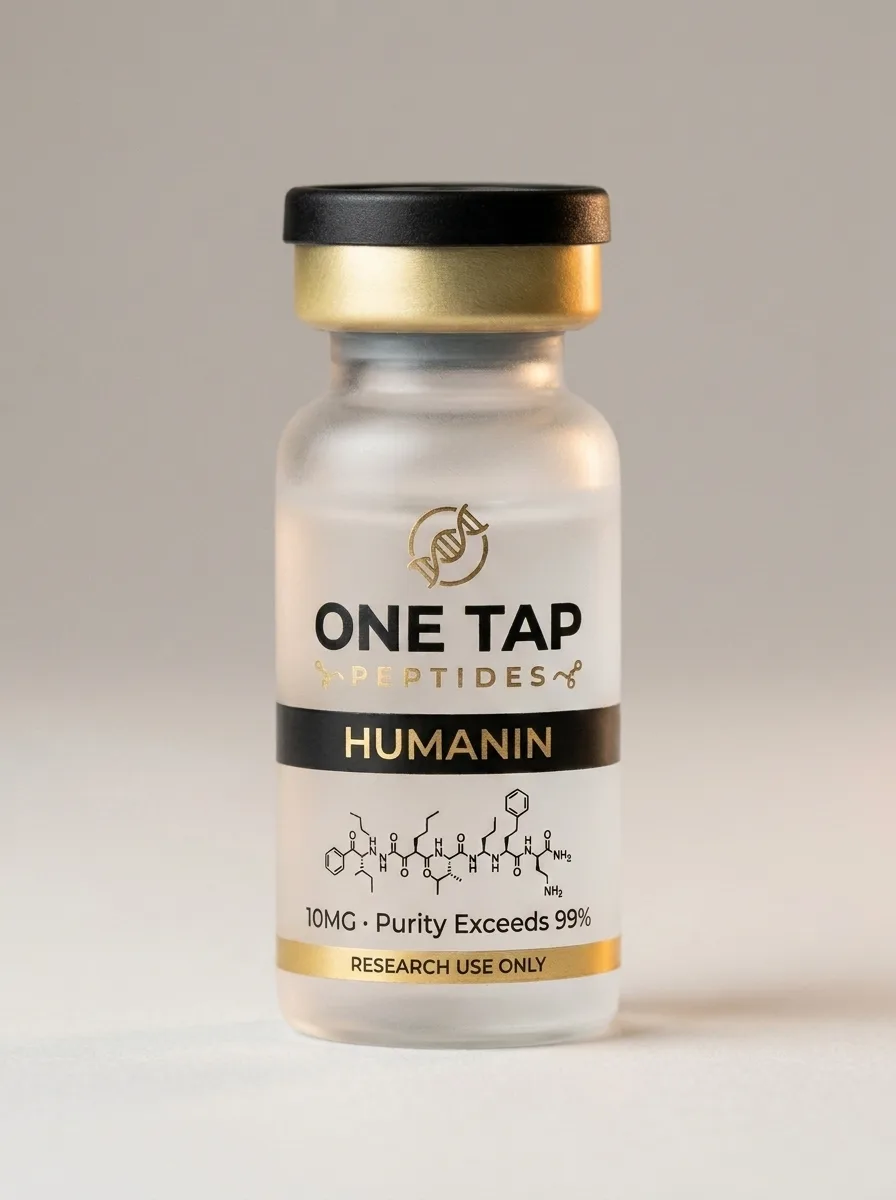
Humanin is a small peptide encoded within mitochondrial DNA, discovered for its cell-protective properties and now studied more broadly in longevity-adjacent cellular research — one of a growing class of mitochondrial-derived peptides that includes MOTS-c, already on this site.
Research Areas
- Studied for its mitochondrial-DNA-encoded origin and cell-protective signaling
- Studied for its potential role in cellular-stress-response research
- Studied alongside other mitochondrial-derived peptides for comparative longevity-pathway research
Batch & Testing
Proof, not promises.
COA ships with every order
The Certificate of Analysis for your batch ships in the box with your order. We're publishing the certificate archive here next.
Research Deep-Dive
How it works.
Research Deep-Dive
How it works.
Humanin is a small peptide encoded within mitochondrial DNA rather than the nuclear genome, discovered originally for cell-protective properties and now studied more broadly within a growing research class of mitochondrial-derived peptides that also includes MOTS-c, elsewhere in this catalog.
It's studied for interacting with cell-surface and intracellular receptors involved in stress-response and cell-survival signaling, examined for how mitochondria may communicate their metabolic state to the rest of the cell through peptides like this one.
Use Cases Explored
- Studied for its mitochondrial-DNA-encoded origin and cell-protective signaling
- Studied for its potential role in cellular-stress-response research
- Studied alongside other mitochondrial-derived peptides for comparative longevity-pathway research
The Evidence
Preclinical and cell-culture research
Humanin's cell-protective signaling has been documented mainly in cell-culture and animal-model studies across various stress-response contexts; human clinical trial data specific to this peptide is limited.
Emerging research class
As part of the newer mitochondrial-derived-peptide research area, the overall evidence base is smaller and less consolidated than for more established peptide classes in this catalog.
Specifications
The essentials.
Specifications
The essentials.
- Form
- Lyophilized powder
- Storage
- Store in a cool, dry place. Refrigerate at 2–8°C after reconstitution
- Shelf life
- 24 months lyophilized; 4–6 weeks refrigerated after reconstitution
- Solubility
- Reconstitute with bacteriostatic water
- Vial capacity
- 3 ml glass vial
Questions
Humanin FAQ
Questions
Humanin FAQ
What is Humanin studied for?+
Humanin is studied for its mitochondrial-DNA-encoded origin and cell-protective signaling, examined for a potential role in cellular-stress-response research within longevity-adjacent research programs.
How does Humanin relate to MOTS-c, also sold here?+
Both are mitochondrial-DNA-encoded peptides studied within a growing research class of mitochondrial-derived peptides, though they have distinct sequences and are examined for different downstream signaling effects.
How should Humanin be handled and stored?+
It ships as a lyophilized powder. Reconstitute with bacteriostatic water and refrigerate at 2–8°C after mixing — good for roughly 4–6 weeks refrigerated, or up to 24 months unreconstituted in a cool, dry place.
What testing does this batch undergo?+
Every batch is HPLC tested for purity and identity, plus sterility and endotoxin screening, before release. The Certificate of Analysis for that lot ships with your order.
Cellular & Longevity
Humanin
Mitochondrial-derived peptide
A mitochondrial-DNA-encoded peptide studied for cellular-protective and longevity-pathway research.
Size
Ships within 24 hours · $20 flat shipping · Free over $200
Pay simply and securely via Zelle or Apple Pay (Apple Cash) — instructions are emailed the moment you order. How payment works →
Satisfaction guarantee — if a batch's documentation doesn't check out, contact support and we'll make it right.
All products sold by One Tap Peptides are intended for laboratory research use only. Not for human consumption. Not intended for animal use. Not intended for diagnostic or therapeutic purposes.
Related