





Overview
What it is.
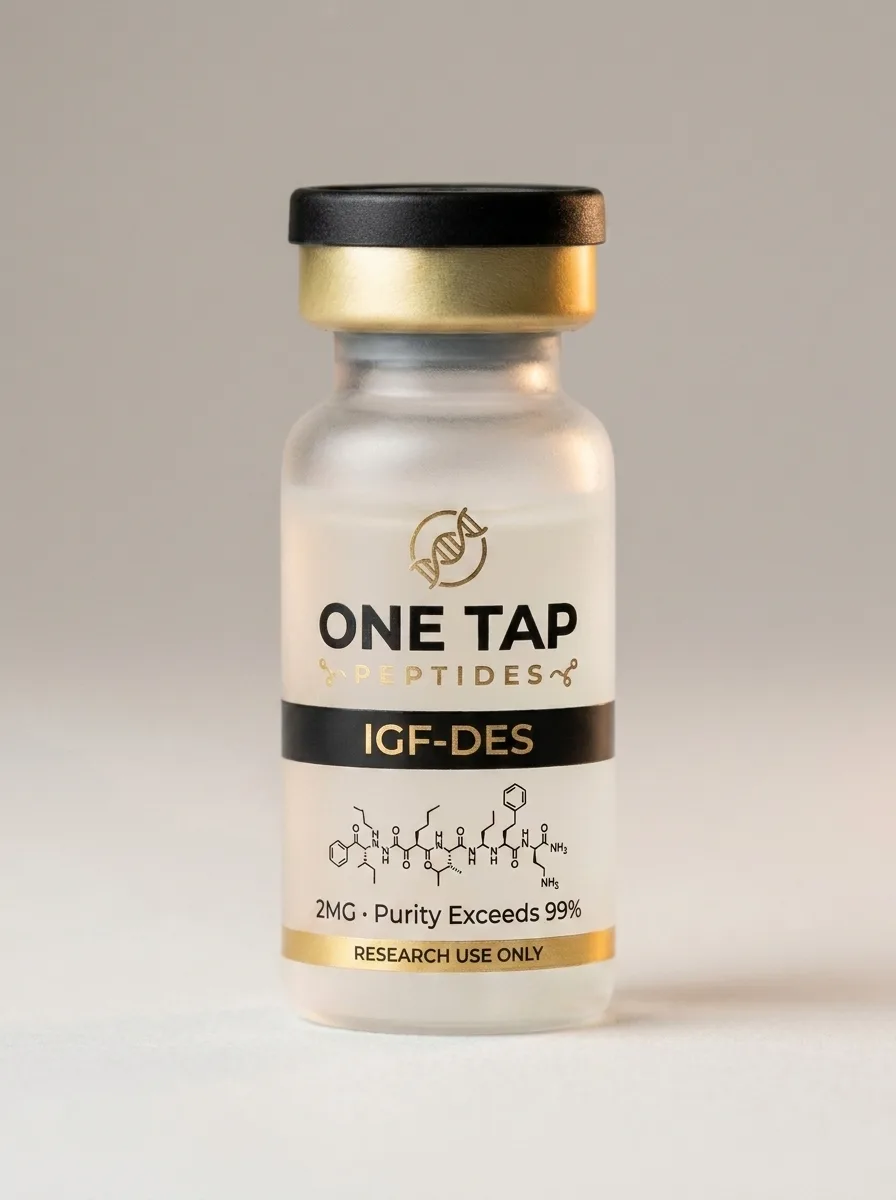
IGF-DES is a truncated variant of IGF-1 missing its first three amino acids, a modification studied for reducing binding to IGF-binding proteins relative to full-length IGF-1 — producing a shorter, more localized signaling window studied separately from IGF-1 LR3's long-acting profile.
Research Areas
- Studied for its truncated structure and reduced IGF-binding-protein affinity
- Studied for its potential role in localized muscle-tissue growth-factor signaling
- Studied as a shorter-acting comparator to IGF-1 LR3 in growth-factor research
Batch & Testing
Proof, not promises.
COA ships with every order
The Certificate of Analysis for your batch ships in the box with your order. We're publishing the certificate archive here next.
Research Deep-Dive
How it works.
Research Deep-Dive
How it works.
IGF-DES (Des(1-3) IGF-1) is a truncated variant of insulin-like growth factor 1, missing its first three amino acids. That modification is studied for reducing the molecule's binding to IGF-binding proteins relative to full-length IGF-1.
Full-length IGF-1 circulates largely bound to binding proteins that regulate its availability; because IGF-DES binds those proteins poorly, it's studied for producing a shorter, more localized signaling window at the tissue level rather than prolonged systemic exposure.
Use Cases Explored
- Studied for its truncated structure and reduced IGF-binding-protein affinity
- Studied for its potential role in localized muscle-tissue growth-factor signaling
- Studied as a shorter-acting comparator to IGF-1 LR3
The Evidence
Preclinical / in vitro research
IGF-DES's reduced binding-protein affinity and altered signaling kinetics are documented in cell-culture and animal-model studies; there is limited human clinical research specific to this analog.
Comparative IGF-1-analog research
Much of what's known about IGF-DES comes from studies designed to compare it against full-length IGF-1 or IGF-1 LR3 rather than standalone characterization.
Specifications
The essentials.
Specifications
The essentials.
- Form
- Lyophilized powder
- Storage
- Store in a cool, dry place. Refrigerate at 2–8°C after reconstitution
- Shelf life
- 24 months lyophilized; 4–6 weeks refrigerated after reconstitution
- Solubility
- Reconstitute with bacteriostatic water
- Vial capacity
- 3 ml glass vial
Questions
IGF-DES FAQ
Questions
IGF-DES FAQ
What is IGF-DES studied for?+
IGF-DES is studied for its truncated structure and reduced IGF-binding-protein affinity, examined for a potential role in localized muscle-tissue growth-factor signaling.
How does IGF-DES differ from IGF-1 LR3, also on this site?+
IGF-DES is studied as a shorter-acting comparator with a more localized signaling window, while IGF-1 LR3 is engineered for a longer half-life and broader circulating exposure.
How should IGF-DES be handled and stored?+
It ships as a lyophilized powder in a single 2 mg size. Reconstitute with bacteriostatic water and refrigerate at 2–8°C after mixing — good for roughly 4–6 weeks refrigerated, or up to 24 months unreconstituted in a cool, dry place.
What testing does this batch undergo?+
Every batch is HPLC tested for purity and identity, plus sterility and endotoxin screening, before release. The Certificate of Analysis for that lot ships with your order.
Growth Hormone
IGF-DES
Des(1-3) IGF-1
A truncated IGF-1 analog studied for a shorter, more localized growth-factor signaling window.
Size
Multi-vial pricing
Per-vial pricing, applied automatically. No code needed.
Ships within 24 hours · $20 flat shipping · Free over $200
Pay simply and securely via Zelle or Apple Pay (Apple Cash) — instructions are emailed the moment you order. How payment works →
Satisfaction guarantee — if a batch's documentation doesn't check out, contact support and we'll make it right.
All products sold by One Tap Peptides are intended for laboratory research use only. Not for human consumption. Not intended for animal use. Not intended for diagnostic or therapeutic purposes.
Related