







Overview
What it is.
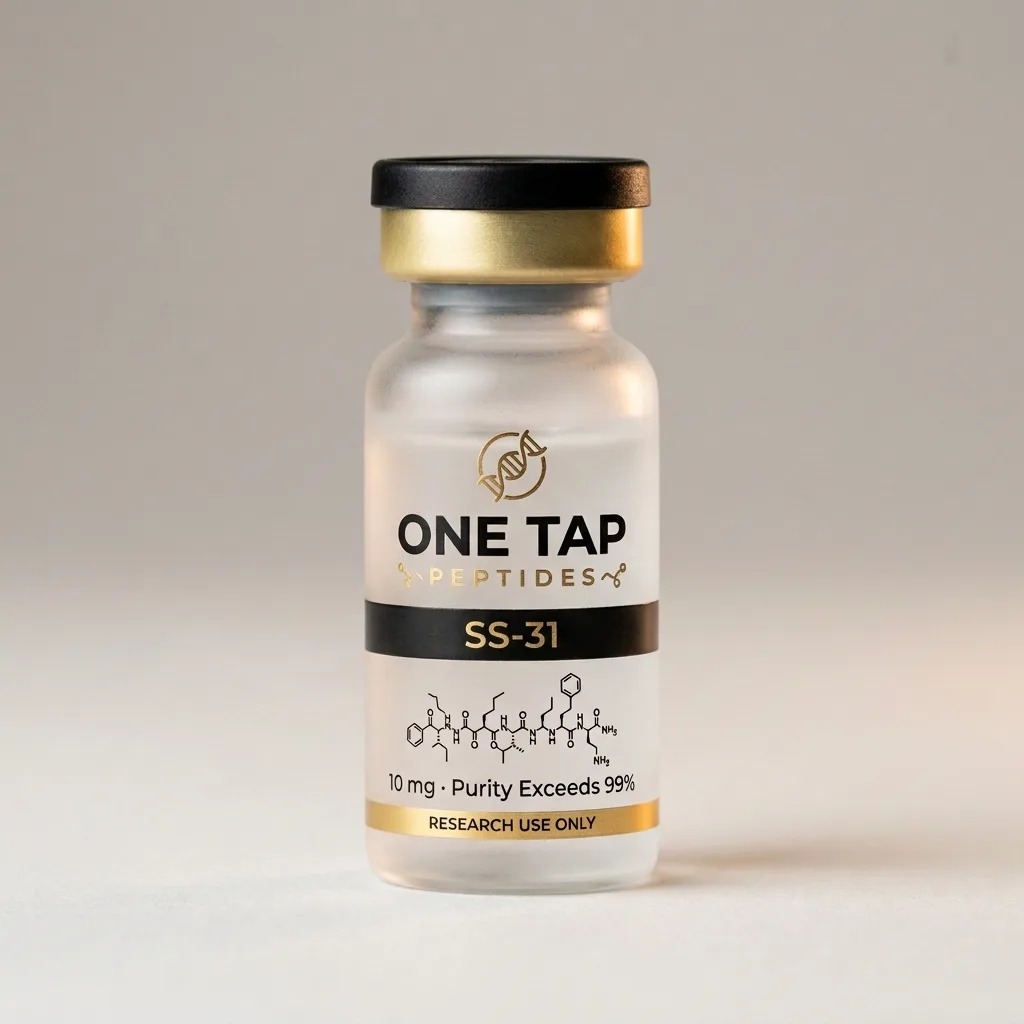
SS-31, also known as elamipretide, is a peptide designed to concentrate in mitochondria and support the membrane structures involved in cellular-energy production. It has one of the deeper formal clinical-trial research records in this category.
Research Areas
- Studied in clinical trials for its potential role in mitochondrial-membrane-function research
- Studied for its potential role in cellular-energy-production research under stress
- Studied in defined research populations for mitochondrial-related outcomes
Batch & Testing
Proof, not promises.
COA ships with every order
The Certificate of Analysis for your batch ships in the box with your order. We're publishing the certificate archive here next.
Research Deep-Dive
How it works.
Research Deep-Dive
How it works.
SS-31, also known as elamipretide, is a peptide engineered to concentrate inside mitochondria and stabilize the inner mitochondrial membrane. Unlike most peptides discussed on this site, it has gone through a formal pharmaceutical development and FDA review process rather than remaining purely investigational or gray-market.
Elamipretide binds cardiolipin, a lipid concentrated in the inner mitochondrial membrane, and is studied for helping preserve the membrane structure that mitochondria depend on for efficient energy production, particularly under cellular stress.
Use Cases Explored
- Studied in formal clinical trials for a potential role in mitochondrial membrane function
- Studied for a potential role in cellular energy production under metabolic stress
- Studied in defined patient populations with mitochondrial-related conditions
The Evidence
FDA accelerated approval — Barth syndrome (as Forzinity, 2025)
After an initial 2021 filing the FDA declined to accept and a 2025 complete response letter on a resubmission, elamipretide received FDA accelerated approval in September 2025 for improving muscle strength in Barth syndrome, under the brand name Forzinity — a narrow, rare-disease indication, not a general longevity approval.
TAZPOWER / open-label extension data
The approval leaned on results from the Phase 2/3 TAZPOWER study; the randomized crossover phase missed its primary endpoint, and the case for approval ultimately rested on functional improvements in a small (n=10, 8 completers), open-label 168-week extension — data an independent expert cautioned cannot be compared to a placebo-controlled trial.
Primary mitochondrial myopathy — pivotal trial missed endpoints
A separate pivotal Phase 3 trial in primary mitochondrial myopathy did not meet its primary endpoints (6-minute walk distance and symptom score), illustrating how difficult mitochondrial-disease outcomes are to move and measure even for a molecule with a strong preclinical rationale.
Broader trial program (dry AMD, heart failure, ischemia-reperfusion)
Elamipretide has also been studied in dry age-related macular degeneration and cardiac contexts, with a mixed record across that broader program that defines both the promise and the real limits of mitochondria-targeted peptide therapy.
Specifications
The essentials.
Specifications
The essentials.
- Form
- Lyophilized powder
- Storage
- Store in a cool, dry place. Refrigerate at 2–8°C after reconstitution
- Shelf life
- 24 months lyophilized; 4–6 weeks refrigerated after reconstitution
- Solubility
- Reconstitute with bacteriostatic water
- Vial capacity
- 3 ml glass vial
Questions
SS-31 FAQ
Questions
SS-31 FAQ
What is SS-31 studied for?+
SS-31 (elamipretide) is studied in clinical trials for its role in mitochondrial-membrane-function research and cellular-energy production under stress, in defined research populations for mitochondrial-related outcomes.
Why is SS-31 considered mitochondria-targeted specifically?+
It's designed to concentrate in mitochondria and support the membrane structures involved in cellular-energy production, rather than acting broadly across the cell.
How should SS-31 be handled and stored?+
It ships as a lyophilized powder. Reconstitute with bacteriostatic water and refrigerate at 2–8°C after mixing — good for roughly 4–6 weeks refrigerated, or up to 24 months unreconstituted in a cool, dry place.
What testing does this batch undergo?+
Every batch is HPLC tested for purity and identity, plus sterility and endotoxin screening, before release. The Certificate of Analysis for that lot ships with your order.
Cellular & Longevity
SS-31
Elamipretide, Bendavia
A mitochondria-targeted peptide studied in formal clinical research for mitochondrial-membrane function.
Size
Multi-vial pricing
Per-vial pricing, applied automatically. No code needed.
Ships within 24 hours · $20 flat shipping · Free over $200
Pay simply and securely via Zelle or Apple Pay (Apple Cash) — instructions are emailed the moment you order. How payment works →
Satisfaction guarantee — if a batch's documentation doesn't check out, contact support and we'll make it right.
All products sold by One Tap Peptides are intended for laboratory research use only. Not for human consumption. Not intended for animal use. Not intended for diagnostic or therapeutic purposes.
Related